Meshy just flipped the script on AI in gaming. At GDC 2026, the company behind one of the most popular AI 3D generators unveiled Meshy Labs, an experimental incubator — and dropped its first game: Black Box: Infinite Arsenal, a survivor-style title where the AI doesn’t just build the assets. It generates the gameplay logic in real time.

From 3D Asset Generator to Gameplay Engine
If you’ve been following the AI 3D space, you know Meshy. Ten million users, $30M ARR, and one of the fastest text-to-3D pipelines available. Their Meshy 6 model just shipped with dramatically improved geometry — smoother organic forms, better structural consistency, and batch generation for up to 10 assets at once.
But the real bombshell at GDC wasn’t Meshy 6. It was the announcement that Meshy is moving beyond asset creation entirely.

CEO Ethan Hu — MIT PhD, creator of the Taichi GPU programming language — calls it the shift from “AI for 3D” to “AI for Fun.” The idea: AI shouldn’t just help developers make games faster. It should fundamentally change how games are played.
Black Box: Infinite Arsenal — How It Works
Black Box is a survivor-style game, but there are no fixed weapon databases. No hardcoded builds. No preset loadouts. Instead, players type text prompts to create their arsenal in real time.
Behind the scenes, a “Designer Agent” interprets your prompt and dynamically assembles the gameplay mechanics — trajectories, physics interactions, elemental effects, damage models. Every session generates weapons, interactions, and rules that have never existed before.
Want a gravity-bending plasma whip that chains between enemies? Type it. A shield that absorbs fire damage and converts it into healing? Type it. The AI builds it on the fly. You’re not selecting from a menu — you’re co-creating the game’s mechanics as you play.
This addresses one of gaming’s oldest problems: content fatigue. No matter how massive a game’s weapon pool is, players eventually see everything. Black Box makes that mathematically impossible.
The Bigger Picture: AI-Native Games Are Coming
Black Box isn’t just a tech demo. It signals a category shift. Until now, AI in gaming has been about acceleration — faster asset creation, smarter NPCs, procedural terrain. The underlying game design remained human-authored and static.
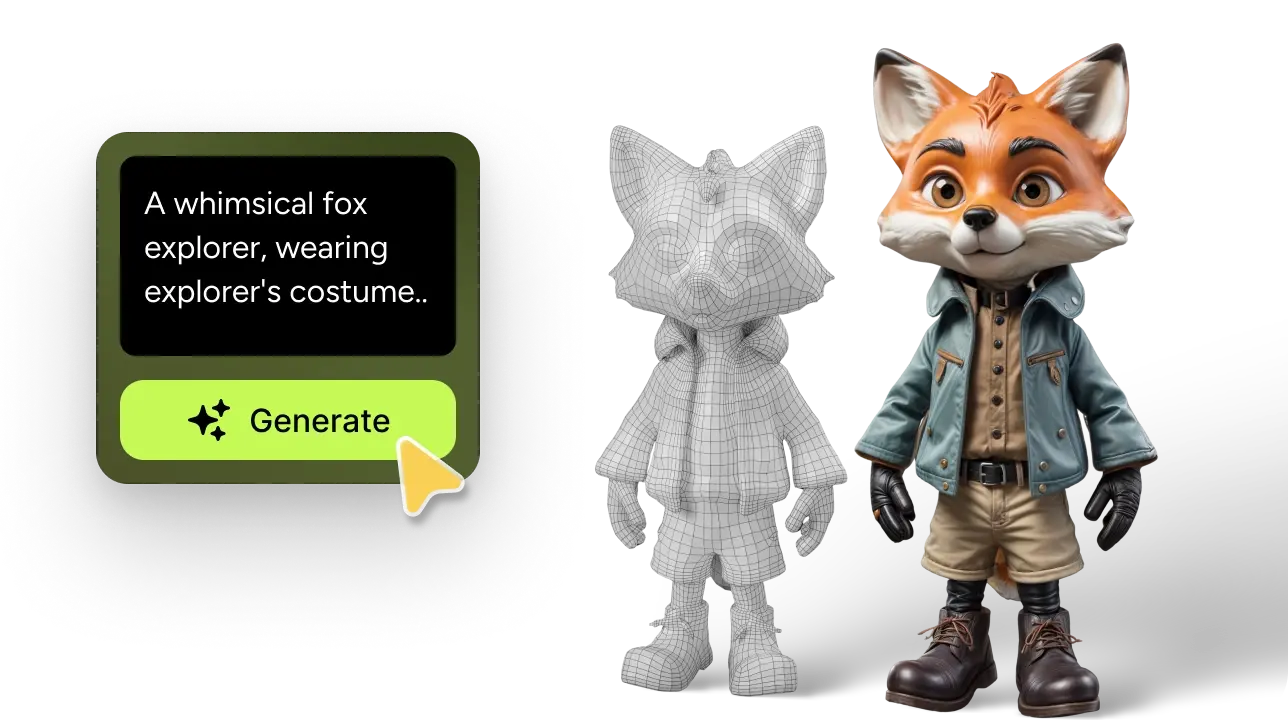
Meshy Labs is betting that the next frontier is AI-native game design — where the AI isn’t a tool in the pipeline, it IS the pipeline. Players become co-designers. Every session is a unique creative act. The boundary between playing and creating dissolves.
This has massive implications beyond gaming. Think architectural walkthroughs where the AI generates interactive scenarios on demand. Or training simulations that adapt in real time. Or creative sandboxes where the rules themselves are procedural.
Why You Should Care
Meshy has the scale (10M users), the revenue ($30M ARR), and the technical chops (MIT-pedigreed team, state-of-the-art 3D generation) to actually pull this off. This isn’t a startup pitching a slide deck — they showed a playable demo at GDC Booth #941.
If AI-native gameplay works at scale, it rewrites the economics of game development. Smaller studios could ship games with infinite content variety. Modding communities could generate entirely new game modes through natural language. The player-creator spectrum collapses.
Try It / Follow Them
- Meshy Platform: meshy.ai
- Meshy 6 (3D generation): Launch blog post
- GDC 2026 announcement: Full press release
- API access: docs.meshy.ai
IK3D Lab Take
This is the most exciting announcement from GDC 2026 for anyone working at the intersection of AI and interactive content. The shift from “AI makes assets” to “AI generates gameplay” is a genuine paradigm break. The big question is balance — can an AI Designer Agent create mechanics that feel as tight and intentional as hand-designed systems? If Meshy cracks that, they won’t just be a 3D tool company anymore. They’ll be a game engine.